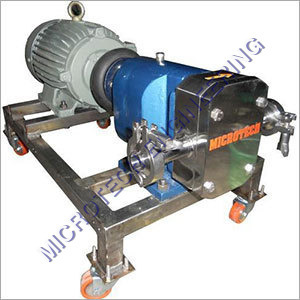
About Positive Rotary Lobe Pumps
Positive Rotary Lobe Pumps Specifications:
- As the rotors start to rotate, an expanding cavity is formed by rotation of the lobes which creates a vacuum at the inlet port, drawing liquid in pumping chamber.
- The product liquid is carried between the lobes and positively displaced, thereby sealing itself against the internal faces of the pump casing.
- The other lobe chamber is filed with the product liquid and about to commence it's discharge cycle.
- Finally the product liquid is forced or pressed out of discharge port of the pump in continuous smooth flow and pressure generated by the meshing of the lobe rotors
MICROTECH ENGINEERING Lobe pumps are used in a variety of industries including, pulp and paper, chemical, food, beverage, Pharmaceutical, and biotechnology. They are popular in these Diverse industries because they offer superb sanitary qualities, high efficiency, reliability, corrosion resistance, and good clean-in-place and sterilize-in-place (CIP/SIP) characteristics.These pumps offer a variety of lobe options including single, biwing, tri-lobe (shown), and multi-lobe.Rotary lobe pumps are Non-contacting and have large pumping chambers, allowing them to handle solids such as cherries or olives without damage. They are also used to handle slurries, pastes, and a wide variety of other liquids. If wetted, they offer self- priming performance. A gentle pumping action minimizes product degradation. They also offer reversible flows and can operate dry for long periods of time. Flow is relatively independent of changes in process pressure, so output is constant and continuous.
How Lobe Pumps Work Liquid flows into the cavity and is trapped by the lobes as they rotate.
Lobe pumps are similar to external gear pumps in operation in that fluid flows around the interior of the casing. Unlike external gear pumps, however, the lobes do not make contact. Lobe contact is prevented by external timinggears located in the gearbox. Pump shaft support bearings are located in the gearbox, and since the bearings are out of the pumped liquid, pressure is limited by bearing location and shaft deflection.
Advantages
- Pass medium solids
- No metal-to-metal contact
- Superior CIP/SIP capabilities
- Long term dry run (with lubrication to seals)
- Non-pulsating discharge
Disadvantages
- Requires timing gears
- Requires two seals
- Reduced lift with thin
Application
Alcohol - Apple pure Apricots - Baby food Batter Beans Beer Beetroot - Biscuit Cream Blackcurrants Brine Broth -Butter fat Caramel - Castor Oil - Cat food - Cheese curd - Cheese whey Cherries - Chicken paste - Chili con Carne Chocolate Chutney Cockles - Coconut oil - Cod oil Coffee liquor Cordials -Corn oil- Corn syrup Cottage cheese - Cotton seed oil Cranberry --- juice - Cream Cream cheese Custard - Dog food Dough Eggs whole - Egg yolk Essences Evaporated milk -Fish - Iodine - ointment etc
Versatile Pump Design for Challenging ApplicationsDesigned to meet rigorous GMP and FDA standards, these rotary lobe pumps are suitable for processing a wide array of viscous and shear-sensitive materials. Their self-priming action, reversible rotation, and customizable connection types make them adaptable for unique process requirements. The single or double jacketed housing supports fluid temperature regulation, while a hygienic mirror-polished finish ensures optimal cleanliness.
Superior Hygiene and Maintenance EaseWith full internal and external mirror polishing, these pumps are easy to clean and resistant to contamination. They are capable of CIP (Clean-In-Place) and SIP (Sterilize-In-Place) operations, reducing downtime and streamlining maintenance routines. Coupled with easy-to-replace components, these pumps guarantee operational efficiency and long service life in demanding environments.
FAQs of Positive Rotary Lobe Pumps:
Q: How does a positive rotary lobe pump handle high-viscosity or shear-sensitive fluids?
A: Positive rotary lobe pumps use synchronized tri-lobe or bi-lobe rotors, creating gentle displacement that minimizes shear and efficiently transfers thick or delicate fluids (up to 1,000,000 cP viscosity) without causing damage to the product.
Q: What are the maintenance requirements and benefits of CIP/SIP compatible lobe pumps?
A: These pumps are designed for ease of maintenance, with smooth surfaces and mirror-polished finishes that prevent residue build-up. CIP/SIP compatibility allows automated internal cleaning and sterilization without dismantling, reducing maintenance time and ensuring hygiene.
Q: When should I select a single jacketed versus double jacketed pump housing?
A: Choose single jacketed housing for standard temperature regulation. Opt for double jacketed versions when aggressive temperature control is necessary, such as handling heat-sensitive or temperature-critical products, ensuring optimal media consistency and process safety.
Q: Where can positive rotary lobe pumps be used effectively?
A: These pumps are widely utilized in food, dairy, beverage, pharmaceutical, cosmetic, and chemical processing applications where precise, hygienic, and gentle fluid handling is essential for product quality and regulatory compliance.
Q: What connection and port orientation options are available for installation flexibility?
A: Multiple connection types (Tri-Clamp, SMS, DIN, Flanged) and customizable horizontal or vertical port orientations make these pumps suitable for diverse piping configurations, facilitating integration into new or existing systems.
Q: How does the self-priming feature benefit my process?
A: Self-priming up to 7 meters allows the pump to evacuate air and draw fluids from various levels without manual priming, simplifying startup and reducing operational complexities especially in demanding installations.

 Send Inquiry



 Send Inquiry

 Send Inquiry

