About Pneumatic Ball Valve
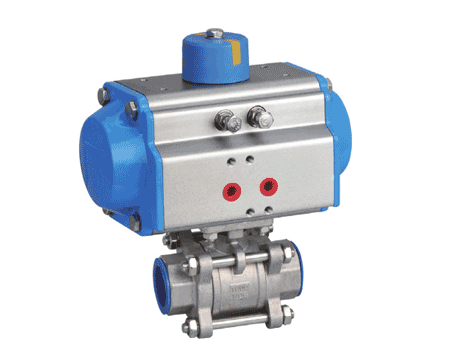
The pneumatic ball valve adopts the two-way double-supply structure. It can be used by the valve and the valve at the same time. The ball valve can be closed and the order can be removed in the state of the front equipment without stopping the work.
Reliable Automation and PerformanceEngineered for industrial automation, the valve integrates a pneumatic actuator and a rugged structure, offering rapid actuation times (1-3 seconds) and long cycle life exceeding a million operations. ISO 5211 compliance and a blow-out-proof stem reinforce its dependability across demanding sectors including water, oil, gas, and chemical processing.
Versatility in Design and ConnectionMultiple body finishes-electro-polished or powder-coated-combined with versatile connection options (threaded, flanged, socket weld) allow seamless integration into varied pipelines. Sizes range from DN15 to DN300 (1/2" to 12") to match diverse application requirements. Optional manual override handles and color finishes provide further customization.
Automation-Friendly OperationThe valve features compatibility with solenoid-driven, PLC, or manual control systems. A visible position indicator and optional limit switch box simplify status monitoring and remote operations, supporting modern automation setups for precise fluid handling across multiple industries.
FAQ's of Pneumatic Ball Valve:
Q: How does the pneumatic actuator operate the ball valve in industrial settings?
A: The valve utilizes either a spring return or double acting pneumatic actuator, receiving compressed air (4-8 bar) to rotate the ball, thereby opening or closing the flow. Actuation generally takes 1 to 3 seconds, providing quick, reliable fluid control for automated systems.
Q: What types of fluids and environments are suitable for this valve?
A: This valve is designed for air, water, gas, oil, and various corrosive fluids. Crafted from robust materials like stainless steel, carbon steel, brass, or PVC, and equipped with industrial or FDA-grade seals, it withstands harsh environments at temperatures from -20C to +80C.
Q: When is it advisable to use spring return versus double acting actuators?
A: Spring return actuators are preferred when automatic fail-safe operation is needed-ensuring the valve closes or opens in case of air supply failure. Double acting actuators are ideal for applications requiring power-driven actuation for both opening and closing, offering more precise control.
Q: Where can the valve be installed, and what connection types are available?
A: The valve can be installed in pipelines requiring threaded, flanged, or socket weld connections, with direct or pad-mounting via ISO 5211 compatible interfaces. Its adaptable mounting options suit various industrial installations and retrofit scenarios.
Q: What accessories and customization options can enhance usage?
A: Optional accessories such as a limit switch box, solenoid valve, positioner, and manual override handle (in stainless steel or plastic) are available. The valve may also be customized for voltage, body color, and seal grade to fit specific operational and regulatory needs.
Q: What benefits does the Class VI (bubble tight) leakage certification provide?
A: Class VI certifies near zero leakage, ensuring a tight seal essential for applications where fluid loss, contamination, or safety concerns are critical. This makes the valve reliable for sensitive processes in industries like pharmaceuticals, food, and chemical manufacturing.

 Send Inquiry



 Send Inquiry

 Send Inquiry

