About Ointment Plant
Ointment Plant
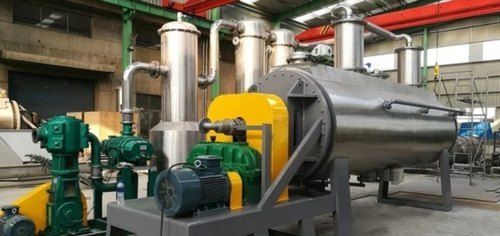
Ointment Section offered comes designed and developed in precision fabricated finish and latest technology support for reliable performance.
Product Details
- Minimum Order Quantity :1 Unit
- Material:SS
- Speed :2800 rpm
- Design: Standard
- Automatic Grade :Semi-Automatic
- Capacity :500-1000L
Features:Rich expertise in offering ointment sections All equipment manufactured using quality stainless steel for reliable end usage
Specifications:Parts of machines manufactured using mild steel Available in varied technical specifications and capacities Water jacketed in SS 304 finish Anchor type stirrer support Homogenizer comprising 5 HP, 2800 RPM, 3 Phase Hydraulic lid lifting support
Advanced Mixing and HomogenizationThe anchor-type agitator with PTFE scrapers and high-speed homogenizer guarantees thorough mixing and uniform consistency for a variety of viscous products. The inline filter assembly ensures smooth operation while the vacuum pump aids in effective deaeration, crucial for pharmaceutical and cosmetic manufacturing.
Superior Construction and ComplianceBuilt from pharmaceutical-grade stainless steel with a mirror-polished interior, the vessel ensures hygiene and easy cleaning. The plant comes with cGMP and CE-compliant documentation and is equipped with essential safety interlocks, food-grade gaskets, and a robust SS304 electrical cabinet with IP55 rating for enhanced reliability.
Efficient Process Control and FlexibilityProcess parameters such as heating, cooling, and mixing are PLC-controlled, offering high automation and customized operation. The system is designed for mobility, batch versatility, and integration into existing production lines, making it ideal for small to large-scale manufacturing environments.
FAQ's of Ointment Plant:
Q: How does the anchor-type agitator with PTFE scrapers improve product homogeneity?
A: The anchor-type agitator with PTFE scrapers promotes thorough mixing by continuously scraping the vessel walls, preventing material buildup and ensuring consistent blending. When paired with a high-speed homogenizer (2800 rpm), the system achieves over 99% batch homogeneity for ointments, creams, and gels.
Q: What are the benefits of using stainless steel (SS316/SS304) with mirror polishing in the vessel's construction?
A: Stainless steel (SS316/SS304) offers chemical resistance and durability, while mirror polishing inside the vessel prevents contamination and facilitates easy cleaning. These features are essential for pharmaceutical and cosmetic manufacturing, meeting strict hygiene and GMP compliance standards.
Q: When should the vacuum pump and deaeration system be operated during production?
A: The vacuum pump and deaeration system are typically activated during and after the mixing process. This removes air bubbles and gases from the formulation, resulting in smoother texture and increased product stability, especially important for ointments and creams.
Q: Where is the product discharge located and how does it function for batch unloading?
A: Product discharge can be configured as either bottom or side outlet fitted with a valve, optimizing batch unloading and transfer. Its design allows for efficient and controlled release of finished product, minimizing wastage and facilitating easy container filling.
Q: What is the process of heating and cooling within the ointment plant?
A: The plant utilizes a jacketed vessel heated or cooled by thermic fluid or water. This system enables controlled temperature adjustment up to 100C, ensuring precise processing of various formulations. Heating and cooling cycles are automated for operational efficiency and product consistency.
Q: How does PLC-controlled automation enhance manufacturing operations?
A: Optional PLC-controlled automation allows users to set, monitor, and adjust key parameters such as mixing speed, temperature, and vacuum levels. This optimizes reproducibility, reduces manual intervention, and supports compliance with industrial standards for batch production.
Q: What are the main usage and applications for this ointment plant?
A: This ointment plant is primarily employed for mixing, preparation, and manufacturing of ointments, gels, and creams in pharmaceutical, cosmetic, and related industries. Its features support high-volume production, cGMP compliance, and adaptability to diverse formulation requirements.

 Send Inquiry





 Send Inquiry

 Send Inquiry

