About Coffee Transfer Pump
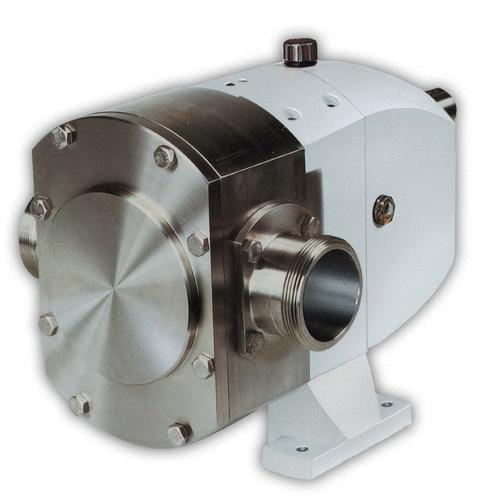
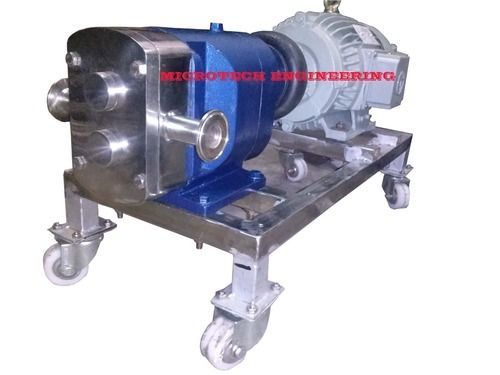
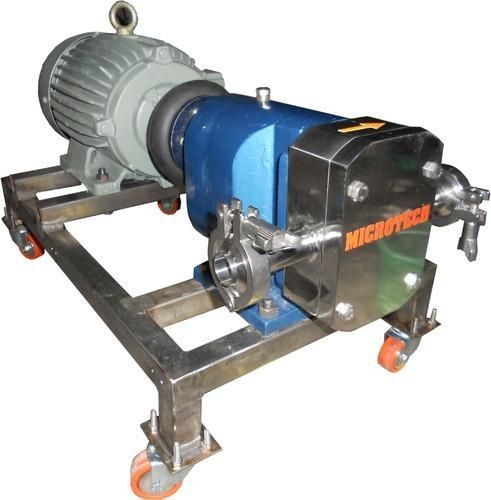
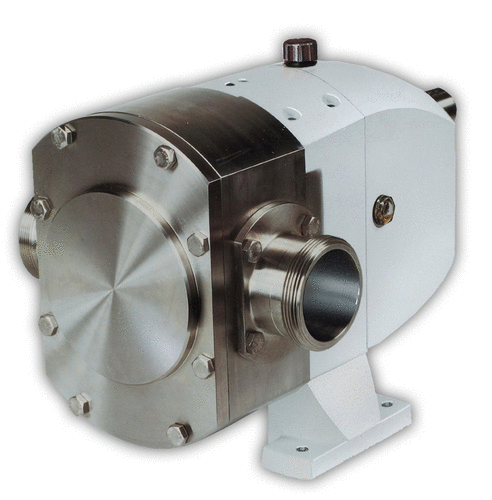
Microtech engineering Lobe pumps are used in a variety of industries including, pulp and paper, chemical, food, beverage, Pharmaceutical, and biotechnology. They are popular in these Diverse industries because they offer superb sanitary qualities, high efficiency, reliability, corrosion resistance, and good clean-in-place and sterilize-in-place (CIP/SIP) characteristics.These pumps offer a variety of lobe options including single, biwing, tri-lobe (shown), and multi-lobe.Rotary lobe pumps are Non-contacting and have large pumping chambers, allowing them to handle solids such as cherries or olives without damage. They are also used to handle slurries, pastes, and a wide variety of other liquids. If wetted, they offer self- priming performance. A gentle pumping action minimizes product degradation. They also offer reversible flows and can operate dry for long periods of time. Flow is relatively independent of changes in process pressure, so output is constant and continuous.
How Lobe Pumps Work Liquid flows into the cavity and is trapped by the lobes as they rotate.
Lobe pumps are similar to external gear pumps in operation in that fluid flows around the interior of the casing. Unlike external gear pumps, however, the lobes do not make contact. Lobe contact is prevented by external timing gears located in the gearbox. Pump shaft support bearings are located in the gearbox, and since the bearings are out of the pumped liquid, pressure is limited by bearing location and shaft deflection.
- As the lobes come out of mesh, they create expanding volume on the inlet side of the pump
- Liquid travels around the interior of the casing in the pockets between the lobes and the casing it does not pass between the lobes.
- Finally, the meshing of the lobes forces liquid through the outlet port under pressure.
Lobe pumps are frequently used in food applications because they handle solids without damaging the product. Particle size pumped can be much larger in lobe pumps than in other Positive Displacement Pump types. Since the lobes do not make contact, and clearances are not as close as in other Positive Displacement Pump, this design handles low viscosity liquids with diminished performance. Loading characteristics are not as good as other designs, and suction ability is low. High-viscosity liquids require reduced speeds to achieve satisfactory performance. Reductions of 25% of rated speed and lower are common with high-viscosity liquids.
Advantages- Pass medium solids
- No metal-to-metal contact
- Superior CIP/SIP capabilities
- Long term dry run (with lubrication to seals)
- Non-pulsating discharge
Disadvantages- Requires timing gears
- Requires two seals
- Reduced lift with thin
ApplicationAlcohol - Apple puree - Apricots - Baby food - Batter - Beans - Beer Beetroot - Biscuit Cream - Blackcurrants - Brine -Broth -Butter fat Caramel - Castor Oil - Cat food - Cheese curd - Cheese whey- Cherries - Chicken paste - Chili con - Carne -Chocolate-Chutney-Cockles - Coconut oil - Cod oil - Coffee -liquor - Cordials -Corn oil- Corn syrup - Cottage - cheese - Cotton seed -oil -Cranberry - juice - Cream -Creamcheese- Custard - Dog food -Dough - Eggs - whole - Egg yolk -Essences - Evaporated-milk -Fish - Iodine - ointment etc
Optimized Fluid Transfer for Coffee and Dairy ApplicationsEngineered for excellence in coffee processing and dairy industries, this transfer pump accommodates a wide range of viscosities and flow requirements. Its single-stage centrifugal operation ensures consistent and gentle liquid movement, safeguarding product integrity. The pump's corrosion-resistant stainless steel construction, low-noise profile, and high-efficiency operation reflect its suitability for demanding sanitary environments.
Advanced Hygiene Standards with CIP CompatibilityThis pump is designed to meet stringent sanitary protocols. The mirror-polished surface finish and availability of EPDM, Silicone, or Viton gaskets facilitate thorough cleaning-in-place (CIP). These features minimize contamination risks, support regulatory compliance, and extend equipment lifespan, making the pump highly advantageous for food and beverage processing.
FAQ's of Coffee Transfer Pump:
Q: How does the Coffee Transfer Pump support cleaning and maintenance processes?
A: The pump is fully compatible with clean-in-place (CIP) protocols. Its mirror-polished stainless steel surfaces and sanitary design facilitate swift, residue-free cleaning, supported by durable EPDM, Silicone, or Viton gaskets. This minimizes downtime and maintains hygiene without disassembly.
Q: What are the benefits of using a centrifugal pump with an open or closed impeller for coffee and milk transfer?
A: Choosing between open and closed impellers allows adaptation to varying viscosities and particulate contents. Open impellers handle high-viscosity liquids up to 600 cP and suspended solids, while closed impellers optimize efficiency with low-viscosity fluids, making the pump versatile for coffee, milk, and beverage applications.
Q: When is it ideal to install the Coffee Transfer Pump?
A: Ideal installation is during equipment upgrades, new plant setups, or process optimization in coffee processing, dairy plants, or beverage industries. The pump's horizontal, base-mounted configuration is suitable for integration into existing or new systems.
Q: Where can the Coffee Transfer Pump be used?
A: This pump is engineered primarily for use in coffee processing plants, dairies, and beverage industries. It is also suitable for other liquid transfer applications requiring sanitary standards, including pharmaceutical or food sectors.
Q: What is the process for handling different liquid viscosities and flow rates?
A: The pump accommodates viscosities up to 600 cP and delivers flow rates between 40 to 300 LPM. Operators adjust parameters such as impeller type, priming method, and motor speed (1400/2800 RPM) to match process demands, ensuring optimal performance across a wide range of fluids.
Q: How does the pump's construction benefit operators in terms of safety and durability?
A: With stainless steel construction (SS304/SS316), IP55 protection class, and corrosion resistance, the pump offers robust durability and safety in challenging environments. Mechanical seals and insulation class F further ensure reliable operation under varying temperature and pressure conditions.

 Send Inquiry



 Send Inquiry

 Send Inquiry

